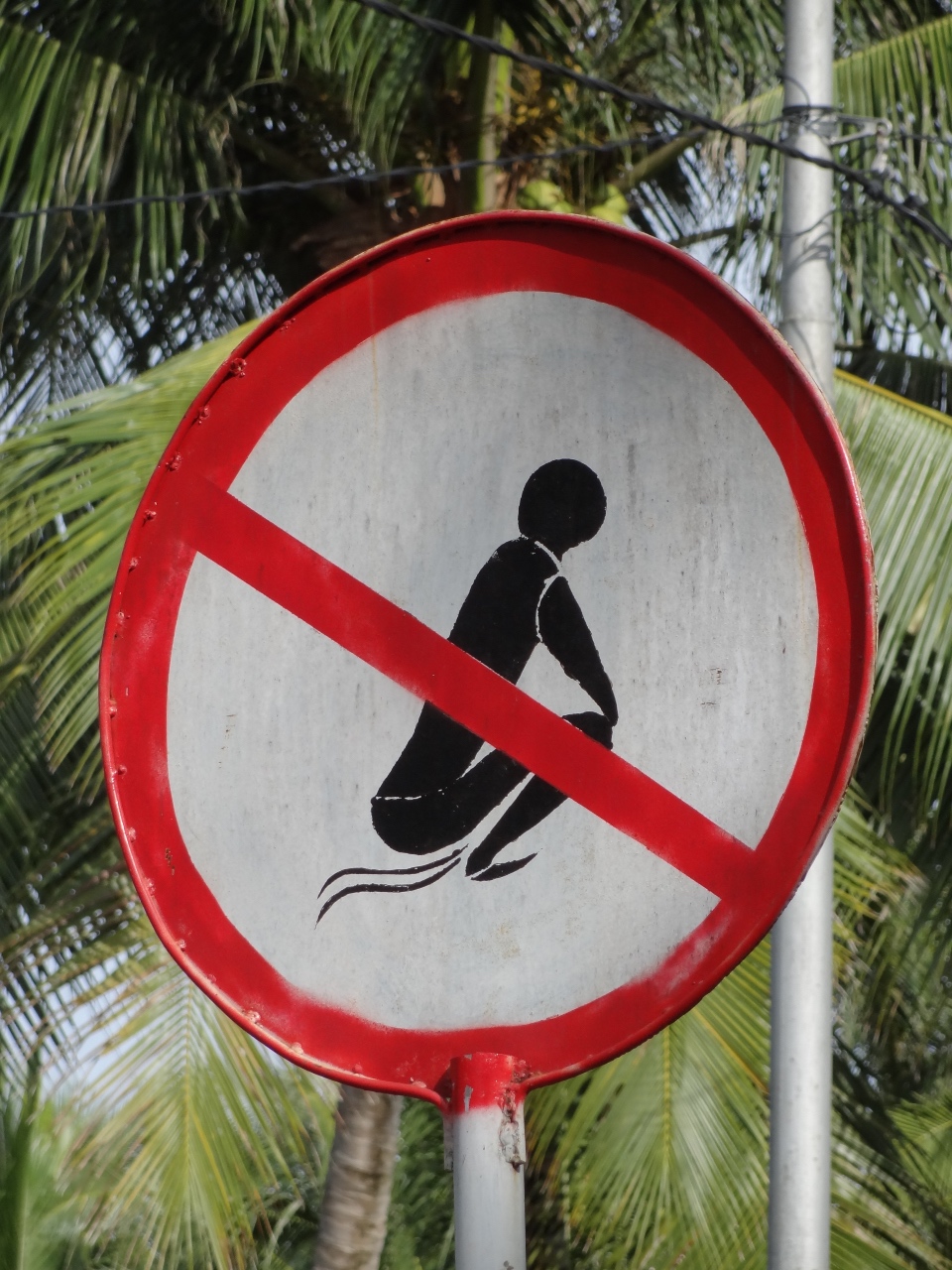
Sign in a Sulawesi village
Q: What does Wellington have in common with a US aircraft carrier?
A: A failing sewage system!
However impressive your city, or vessel, is, if it doesn’t have a working sewage system, you’ve got a problem. In the case of the USS Ford, an aircraft carrier waiting on the coast of Iran in case Trump orders an attack, they’ve got 45 minute queues to go to the head and unhappy sailors. The US navy installed a vacuum sewage system designed for cruise ships that make regular port visits with a laudable intent of reducing water usage. However, a nuclear-powered aircraft carrier can spend weeks or longer at sea – it has a very different operating environment compared with a cruise ship. Sewage system breakdowns have left sections of the carrier without functioning toilets for hours at a time and only a small proportion of the toilets are operational.
Just like the USS Ford, Wellington’s sewage problems are now well known worldwide – 70 million litres of untreated sewage discharged daily 1.8 km offshore due to a catastrophic failure in the treatment system. While this seems unthinkable in ‘modern’ New Zealand, Wellington has only had twenty-eight years of treated sewage outflows; prior to 1988 untreated sewage spewed offshore. This sounds archaic? What’s the deal with Wellington sewage?
In New Zealand of the 1800s, early European settlements, including Wellington, were extremely unhygienic compared with Māori settlements. While Māori separated toilets from storehouses and water sources (and also kept rubbish confined from water sources), new towns built by Europeans had no clean water supply and no safe way to deal with sewage and rubbish. Rubbish was dumped around houses and in the streets. Used water was discharged in open drains and waterways. People dug cesspits in their back yards with toilets above them (as we experienced in Mongolia). Wellington smelt pretty bad (I can attest to how bad close quarters cesspits smell in summer – when we reached Ulan Bataar, the stench was overpowering!)
In Wellington later in the 1800s, rubbish and human waste contaminated water and infectious diseases were common. An 1870 study showed none of the water collected from wells and tanks in central Wellington was safe to drink and all town streams were too polluted to use. In the same year, the council cited ‘sewage-soaked backyards’ as causing 77 deaths from cholera, typhoid, polio and dysentery.
In the 1860s and 1870s, city councils were set up across New Zealand, including in Wellington, with independent powers to strike rates, borrow money and manage municipal affairs. However, property owners were unhappy; they didn’t want to finance sanitary works for the city. Some councillors were property owners with vested interests. Early urban subdivisions had no requirement for proper sanitary arrangements.
In 1872, the NZ Public Health Act banned cesspits and councils instigated night soil collections as a simpler and cheaper option than connected sewage systems. The contents of toilets (night soil) were removed in carts with special wooden tanks and the material was dumped on the edge of town by council contractors who came to be known as ‘night-men’. In some areas, sewer systems didn’t replace night-soil carts until the 1960s. Mum remembers the night-soil men coming when she lived in Prebbleton, near Christchurch, in the 1950s.
In 1874, Wellington started on its sewage infrastructure, burying cast iron pipes. However, the system was constrained by the availability of reticulated water to move waste away through the pipes. In 1899, the first connected public sewerage project was completed in Wellington. It was a gravity fed system with:
- a sewerage network around the harbour;
- a sea outfall at Moa Point;
- a sewerage tunnel through Mt Victoria;
- overflows created by turning existing timber stormwater culverts into brick or concrete.
As the city grew through the 1900s, smaller pipes were laid in the city and its growing suburbs. All the pipes fed into ‘the interceptor’ which took the flows to the Moa Point outfall.
The sewage system continued to expand. In the 1950s, the Kaiwharawhara tunnel and aqueduct created a spine for the network from Ngauranga Gorge to Moa Point. In the 1990s, the Mount Albert wastewater tunnel was built. In 1998, the Moa Point Wastewater Treatment Plant was commissioned together with a new ocean outfall. This took the treated wastewater 1800m offshore into Cook Strait. For the first time, Wellington was discharging treated rather than untreated sewage. However, the new plant didn’t come with new pipes; much of Wellington’s pipe network is very old. In a 2022 report, 32% of the wastewater network was estimated to have poor or very poor condition pipes requiring replacement. The average age of the pipes is 53 years old. In some areas significant lengths of pipe date from the early 1900s. These pipes are all prone to failure and there have been numerous sewage outbursts in Wellington streets in recent years e.g. the 2024 leak in Eastbourne – the Moa Point plant failure is not the only weak point in the system.
Wellington has now has effectively regressed to a 20th century sewage system and that system is underpinned by pipes just post-dating the 19th century. We still don’t know the cause of the recent breakdown in the treatment plant and the length of time to get it functional is also unknown. However, according to the Mayor, it’s all good to swim in the ocean again despite 70 million litres of raw sewage flowing into the sea every day. The Mayor has admitted, however, that while the water quality at the beaches tests as acceptable, no one is sure what offshore water quality is for boaties, surfers and divers.
Will there be disease outbreaks in Wellington as a result of sewage-contaminated water being whipped up in the recent storms? National Public Health Service Medical Officer of Health Dr Jill McKenzie says contamination from sea spray is expected to pose a very low health risk. “Bugs that cause illness do not survive long on dry surfaces and are diluted quickly in the environment. As bacteria are always present in the environment around us, the best protection is to wash and dry hands regularly, especially before preparing or eating food, and after outdoor activities.”
So Wellington may be getting away with its retrogression for now. But the city’s water infrastructure is failing, one way or another, on a regular basis. Whose fault is it? In the end, it’s the ratepayers at large because voters elect councils who promise to cut rates. No money, no infrastructure! This is obviously exacerbated by humans not being clear about imperatives vs nice-to-haves – when our sewage system appears to be functioning we are much more interested in e.g. a new stadium, or cycling infrastructure.
While there have been reports of the Moa Point plant being significantly dysfunctional for the last 4 years, humans don’t tend to act until things break. This is a national and international problem – it’s fun to build new infrastructure! It’s boring having to maintain and repair it. So we build more and more infrastructure without ensuring we have the budget to do the necessary maintenance and repairs. Without that infinite growth which is impossible on a finite planet, one day there will be a reckoning when the cost of maintaining infrastructure is greater than the income that can be directed to maintenance.
The consequence for Wellington of a non-functional sewage system is less clear cut than the consequence of a naval aircraft carrier having to return home from a potential war zone before an attack can be launched. How do you think it might go down in the USA…”Apologies, President Trump, we couldn’t strike against Iran because our toilets weren’t working.” Except…that might be a good thing…


Discover more from Jane Shearer
Subscribe to get the latest posts sent to your email.