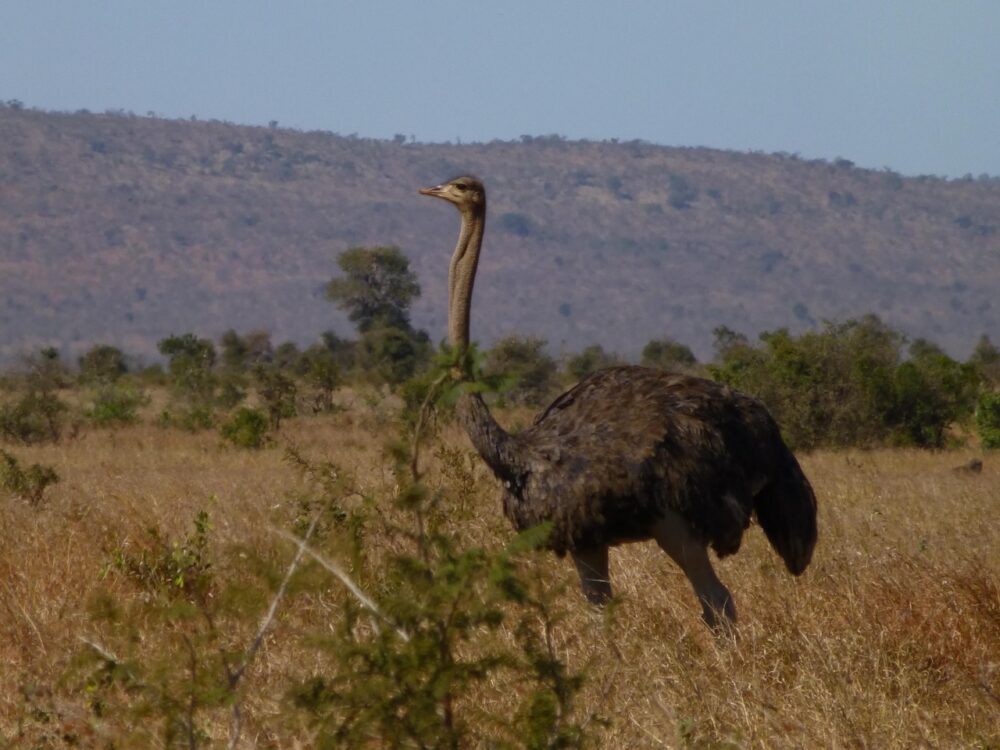
Kenyan ostrich keeping its head well clear of the sand
Do ostriches bury their heads in the sand? I was thinking about how our government doesn’t want to talk about fuel rationing in the face of closure of the Strait of Hormuz? Is it too hard to think about? Or is the government scared of frightening the horses, to mix my metaphorical animals.
The answer is, of course, ostriches do not bury their heads in the sand. Only people. Just like frogs don’t sit in pots waiting to be boiled. Where does the ostrich head burying myth come from? And why don’t people think emus and rheas bury their heads in the sand? Or that moas buried their heads in swamps (maybe they did).
It’s likely the head burying myth originates from people seeing ostriches checking the temperature of their nests. Because ostriches don’t fly, they lay eggs in holes in the ground. To make sure the eggs are evenly heated, they put their heads in the nest to rotate the eggs, which could look like they are trying to hide. Obviously hiding this way wouldn’t work as they’d suffocate with their heads under the ground (or get shot in the rear end). People have also suggested grazing ostriches on uneven ground could look like their heads are buried. Maybe, but then why isn’t there a myth about cows burying their heads in the earth?
On the topic of New Zealand’s available fuel stocks…are we sticking our heads in the sand? Should we be worried? Should the government be enacting the strategic fuel plan, designed for just such a situation where the flow of petroleum products to New Zealand might be restricted?
It seems puzzling the government isn’t enacting a plan designed for the current circumstances; why else was it created? It’s much better to give people plenty of warning that fuel might be restricted so you can ease them into the restrictions. With the Iran war close to its third week, there’s no certainty now that it will be quick. And there’s no certainty the war will end if Trump calls it quits. The battering of Iran has resulted in a new leader who has a very big axe to grind (yes, in the past axes were ground by blacksmiths) because his father, mother and wife were all killed in the same early strike. Supposedly Mojtaba Khamenei wants Trump to apologise, as one of his conditions for ending the war. It will likely be a cold day in hell before Trump apologises to anybody about anything (I can find no evidence of whether there are cold days in hell or not given the lack of evidence that hell exist but if it does exist, it might be called Gaza, Lebanon, Cuba or Iran right now). At present, Trump is proclaiming he finds it a great honour to be killing members of the Iranian regime which doesn’t sound like a path to an apology.
Mojtaba also plans to avenge the deaths of Iranian martyrs and keep the Strait of Hormuz closed until the United States and Israel pay for the damage they have caused. The Strait of Hormuz is a vital shipping route through which 20% of the world’s oil and LNG flow. 84% of the oil and 83% of LNG go to Asian markets, the markets in which New Zealand buys its refined petroleum products. We are a small country at the end of the world; it’s quite likely we won’t be top of the priority list when fuel supplies are low.
The big problem with the Strait of Hormuz is it’s a dead end. And if you are in the western end where you have to get past Iran to escape, you could soon be dead – three ships have been hit by Iranian projectiles so far and the media is full of reports Iran is trying to lay mines across the narrow gap that is the Strait. Ship owners are not going to be keen to have their ships blown up and insurance companies aren’t going to be paying up for the effects of a war – both large disincentives for ships to try to transit, along with the possibility of dying on the way.

By the way, before you start to think New Zealand might have been better off right now if Labour hadn’t sold the Marsden Point refinery a la Shane Jones, Labour didn’t actually have that choice. The owners of the refinery decided it was no longer economic to run. And the refinery was never tuned for New Zealand oil, so even with a refinery, we were still reliant on crude oil shipments coming in from overseas. Not to mention, the refinery processed Middle East crude oil so we’d be in the same boat as we are right now (noting the problem is actually about a lack of boats travelling rather than who is on them).
How much fuel does New Zealand actually have? Do we need to worry?
MBIE published figures last Wednesday and this Wednesday about how much fuel is in the country. The figures were surprisingly hard to find online, or maybe not that surprising given the government wants to keep its head in the metaphorical sand. However, today it looks like MBIE has made them more accessible, perhaps because a whole lot of people are asking about fuel. I asked MBIE to put all the information in one place, in a single table, so we can see how the stocks are changing over time…we will see if I’m successful.

NZ Fuel Stocks 1 March
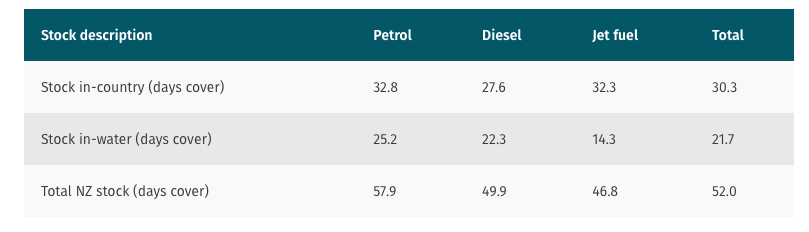
NZ Fuel Stocks 8 March
You could conclude from these figures there’s no immediate issue for New Zealand as we have the better part of two months of fuel here, or coming. You could get a little worried because the fuel that’s on the water (not in-water as in 8 March table, that would be bad!) won’t necessarily make it to New Zealand. There have already been cases of oil ships being turned around and sent to a different destination; maybe one that pays more? And companies are starting to call force majeure to get out of supply contracts – their get out of jail free card for extraordinary events such as wars. Read more about this issue at the NZEnergy substack where Larry does a great job of covering all things NZ energy.
If you are an airline, you might be more worried because it appears jet fuel is already becoming scarce in the global marketplace. Air New Zealand is doubly worried because the price of jet fuel has gone up 80% (jet fuel represents around 25% of ticket costs). AirNZ isn’t waiting for the government to do something, they are cancelling 1100 flights to maximise people transported per unit fuel.
In Asia, governments are already enacting fuel rationing to curb panic buying. Pakistan has closed schools for 2 weeks because they are running out of fuel. Cuba might be happy to hear the rest of the world could be fuel restricted just like them but Cuba is unlikely to hear much news because the US restrictions on fuel imports to Cuba have been so severe, they can’t generate much power any more.
The orange man is wreaking havoc across the planet. Let’s hope…or go stick our heads in the sand until we can’t breathe.


Discover more from Jane Shearer
Subscribe to get the latest posts sent to your email.