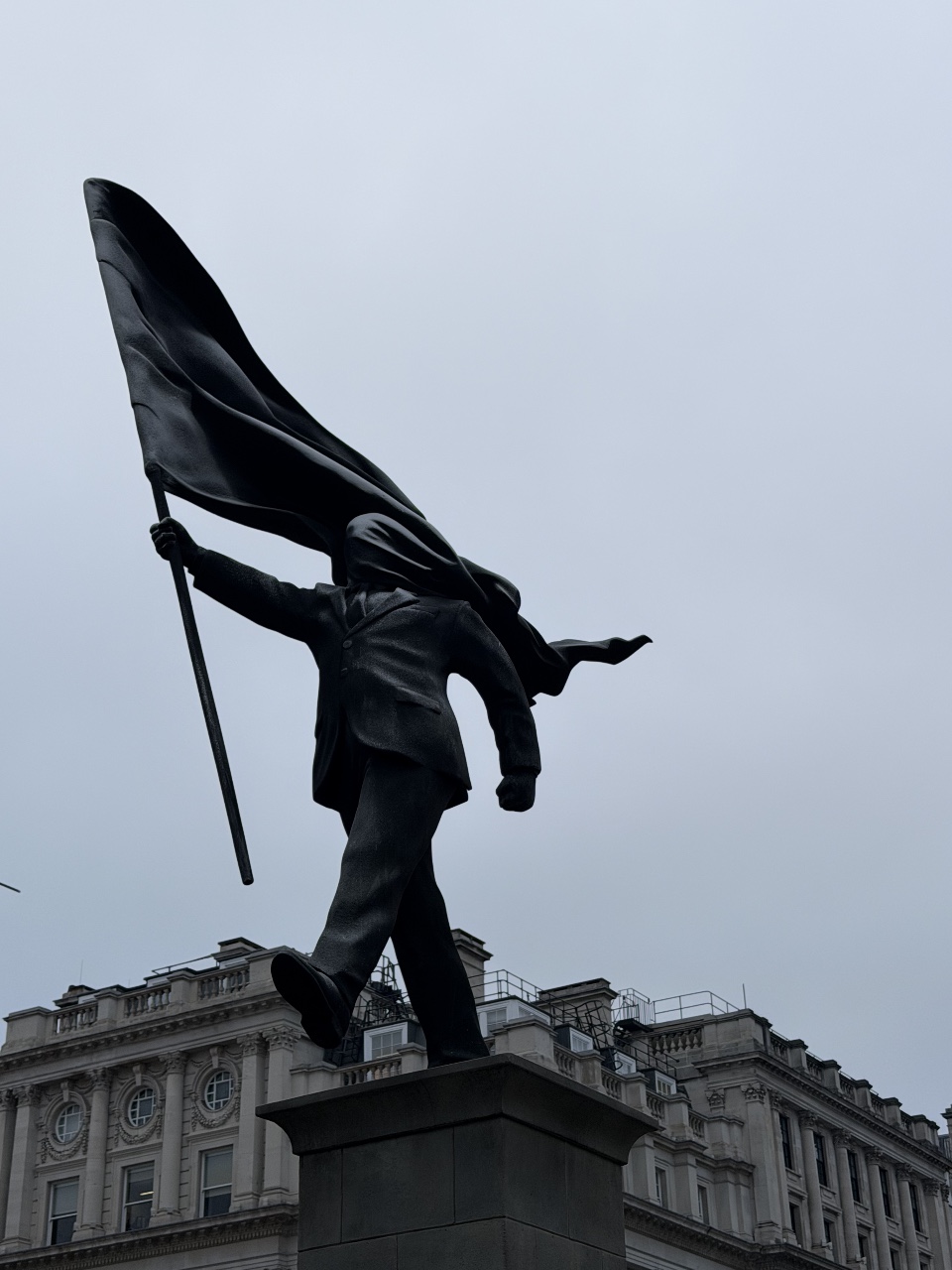
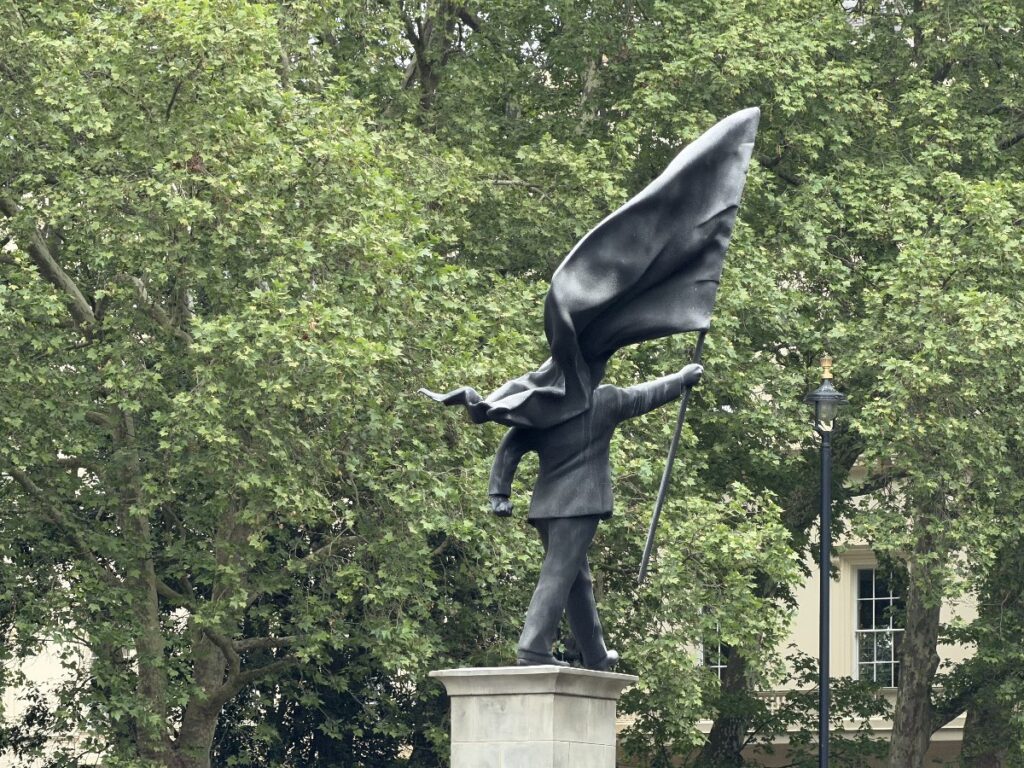
We cycled through central London at 6am to see the new Banksy statue in Waterloo Square free of crowds. The statue doesn’t yet have a name, although some people call it ‘The Politician’. It was installed in the early hours of the morning on the 30th of April; the length of its tenure will be decided by the Westminster City Council.
I was really keen to see the statue. While I’m not overly thrilled by museums (although I often enjoy them when I make the effort), I love public art. I pondered on why Banksy art is particularly appealing for me:
- Ephemerality. Banksy artworks are not intended for the long term but to be an immediate piece of commentary. In Waterloo Square, the resin Banksy contrasts with stone statues of Florence Nightingale and Edward VII. Everything human is ephemeral (everything is ephemeral). I like artworks that celebrate ephemerality in opposition to the general human condition of wanting to keep everything forever.
- Renegade. Banksy publicly pokes at societal mores and assumptions without any apparent overall agenda other than making statements.
- Apparent simplicity of art and message. Most Banksy pieces don’t require a deep knowledge of art or any other realm to interpret them. The art itself appears simple although, as with any such works, it’s a lot harder to make something that looks simple than it appears. Banksy would have put considerable thought into making a structure that could be quickly assembled while allowing ‘The Politician’ to appear to stride off his plinth.
- ‘Copyright is for losers‘. Banksy said this 20 years ago. He champions the right of people to use his images for personal amusement. Banksy also licenses his art royalty-free to charity organisations (such as London-based Loves Welcome, which helps refugee women). Where Banksy pursues copyright (through the entity ‘Pest Control’ – love the name) is when organisations use his images to market their own products. Given Banksy’s lack of marketing, his pursuing copyright to prevent his work being used for marketing seems congruent.
- Humour. Always a big one for me. Many Banksys are funny as well as serious – the best way to get messages across.
- Anonymity. In a world obsessed with being seen, Banksy’s anonymous approach gives him kudos.
As with all Banksy pieces, the meaning of ‘The Politician’ is widely debated. The obvious is blind patriotism – a suited man striding into the abyss with a flag blocking his view. It could be commentary on the dangers of nationalism – adhering strongly to (historic) concepts of the country one lives in without considering the wider context in which that country exists, including historic, strategic and socio-political. When the statue was put up, England was about to have a local body election in which Nigel Farrage was pushing a nationalistic barrow (successfully, as it turns out).
I feel the statue leads to broader thought on what blinds us. Would a statue of Trump have a mirror in front of his face? Would Jacinda Ardern have her eyes covered by the wings of a dove? Does Putin wave an outsize map of the Soviet Union? Every leader has their goals, and every goal can create blindness when the bigger picture is obscured.
Discover more from Jane Shearer
Subscribe to get the latest posts sent to your email.