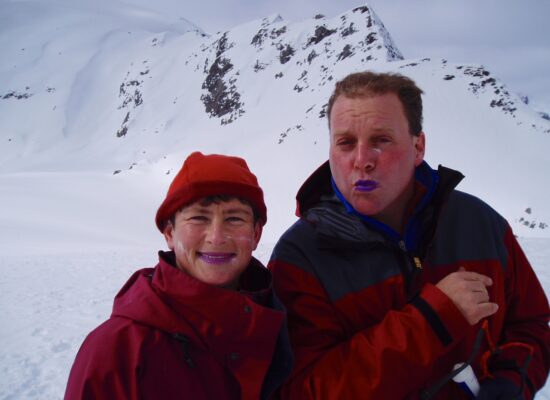
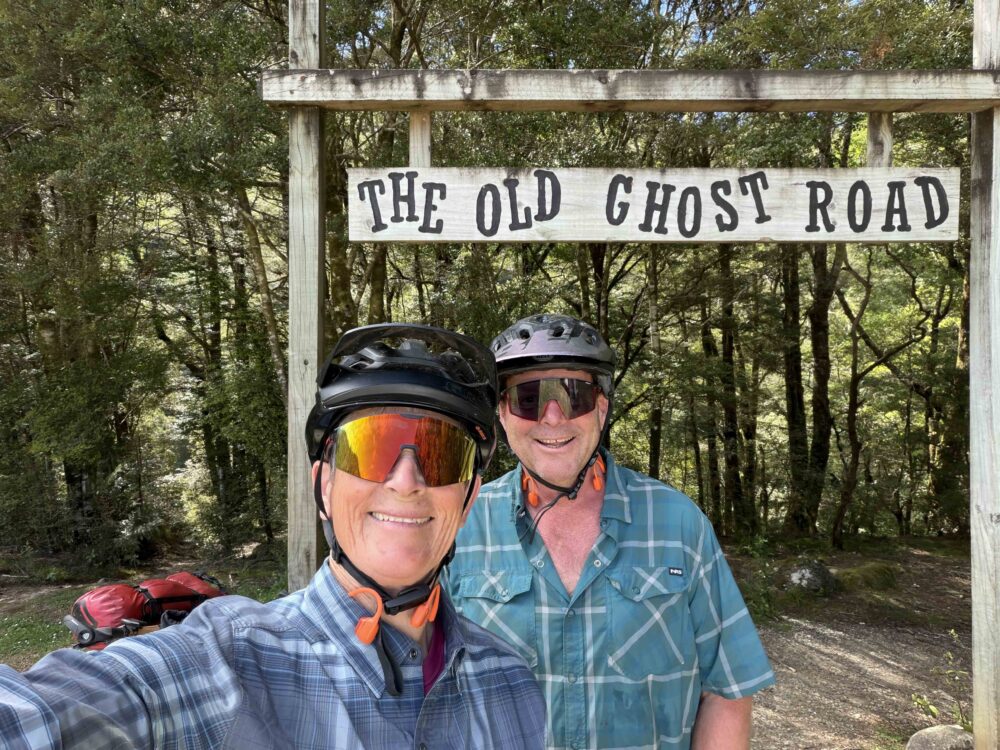
We cycled the Old Ghost Road this week and it was wonderful in multiple dimensions. The Old Ghost Road (OGR) is 85km of trail between Lyell in the Upper Buller Gorge and Seddonville on the Mōhikinui River. You can bike it or tramp it. The trail was developed by the Mōhikinui-Lyell Backcountry Trust but was the vision of Marion Boatwright (Weasel) who we saw working on the track, together with Phil Rossiter who is the current Trust Chair.
The OGR is truly inspired. Weasel’s goal was to join two old gold mining dray roads – one uphill from Lyell and the other along the Mōhikinui River from Seddonville. But how? There was little left of the roads and there were some serious peaks and valleys in the way! A survey had been carried out in 1886 to connect the routes but much of that work was rendered inaccessible by the 1929 Murchison earthquake and the 1968 Inangahua earthquake. There was a ‘ghost’ of a road, which led to the current name of the ‘Old Ghost Road’, but ghosts weren’t enough.
The growing team, led by Weasel and Phil, decided a route could be devised over the tops, rather than the original surveyed track in the river valleys. They raised money, worked with DoC, built track, and built huts, gradually moving from the ends towards the middle (a crucial point being when Meridian gave up on the Mōhikinui dam concept which would have scotched the connection). A critical plank in the funding was $2 million from the New Zealand Cycle Trail project. Once again, I have to thank John Key for putting money into a concept that seemed laughable at the time – a network of cycle trails across New Zealand funded by $50 million – but is now a reality. The Old Ghost Road opened in December 2015 after a gargantuan effort by many over 7 years.
We have cycled the OGR on five occasions. First in 2014 when the northern part of trail had only been completed up to the Lyell tops. Then again in 2016, after it opened. March 2020 was a memorable ride as New Zealand moved towards lockdown. As we drove home with my mother in the car we realised with horror we’d been in huts with people recently arrived on flights from San Francisco and Europe; flights on which people were recorded as having COVID. We returned to the OGR in 2021, cycling from Gibbston to Nelson through all the tracks up the West Coast. And then last week, when we cycled south to north and back north to south to see all the views in the southerly direction we’d never properly looked at. When we were walking uphill to Ghost Lake on the roughest section of track, we got to do a lot of looking.
Every time on the OGR had been a great experience. The views from the tops and the immersion in green West Coast bush are beautiful. The huts are warm, comfortable, equipped with cookers, pans, plates, cutlery and even coffee plungers. Notable on this recent trip, the huts were full of New Zealanders. While the goal of our government may be to push ever more international tourists through our country, there’s a very different feeling of community when your fellow bikers and trampers are New Zealanders.
There were the twins from Hanmer and Mangawhai doing the OGR in 24 hours with their daughters to celebrate their 70th birthday. The Hanmer twin lives next door to Chris’s cousin. There were the six Bush School teachers from Christchurch with whom we shared Canterbury earthquake stories. One of them started her working life as a geologist and studied at the University of Canterbury along with Phil Rossiter so we chatted about geologists we have known. A young couple from Christchurch laughed about how much they need to learn about tramping – they started the track with 22kg packs including bottled water. We talked with a lone cyclist from Christchurch about cycling in the Port Hills and other South Island cycle trails.
We celebrated Rick’s birthday at the Rough & Tumble Lodge. We’d never met Rick but we were included in the birthday group with Rick’s two children, partners and Rick’s four grandaughters. We drank celebratory champagne and agreed about the impossibility of knowing who to vote for in the next election – choosing which is the least worst party; that was a common theme on all three nights of our ride.
When you meet people from your country, or a place you have lived, you are likely to have more in common. When you live near Queenstown and there are 36 visitors to 1 local, it feels really nice to have those connecting conversations. You are reminded how such interactions further create community.
As well as contemplating the pleasant lack of international tourists on the track, I thought about the goals of the builders in terms of boosting the West Coast community economically, environmentally and socially. NZ Cycle Trails evaluated impacts of the OGR in 2025. The reported economic benefit in 2025 was 8,110 visitors (86% New Zealanders) annually cycling or walking on the trail and 37,865 associated visitor nights. The average visitor spent just under $600.
There was a high degree of agreement that the OGR is valued by the local community, has become part of the area’s identity and is improving overall quality of life in the area, as well as creating greater understanding of the area’s natural environment. It’s the community feel of the track that really struck me. Seeing Weasel and Phil and two others working on the huts, chatting with the lovely team of people staffing the Rough and Tumble Lodge at the north end, reading Weasel’s ‘Spirit of the Stone’ about the making of the track (a copy sits in every hut), the story is community. Community made the trail and community is on the trail. Here’s to the builders and maintainers of the Old Ghost Road, they’re a community worth having.
Discover more from Jane Shearer
Subscribe to get the latest posts sent to your email.