

Charlie the feral pheasant – I am also boggled about how to stop Charlie attacking me
New Zealand is at the forefront of the global push to build data centres. AI, and thus data centres that power AI, are being touted as the key to future economic growth. The internationally rhetoric says it’s in a country’s best interests to build lots of data centres as fast as possible.
Data centres are hugely energy consumptive so the push to build more, requiring scaling up energy generation, seems ill matched with our concurrent urgent need to decarbonise energy sources in the interests of preventing massive destabilisation of the planet’s climate. For some people it’s already too late, like those in Nepal’s Trishuli River catchment flooded following collapse of a melting glacier. However, for many the worst is still to come as planetary heating of a minimum of 1.8 degrees Celsius bears down on us. We will breach the originally proposed maximum target of 1.5 degrees of heating this decade. Even worse, humanity’s scale of our consumption means we are breaching many environmental boundaries beyond greenhouse gas emissions. Shouldn’t we focus on reducing the impact or scale of energy use rather than on building more energy infrastructure?
The New Zealand government is currently chasing up to NZD35B of private investment to build an AI data centre industry. A meeting for 100 business leaders was held in Auckland in July proposing a vision for a future where New Zealand capitalises on the AI revolution by building clusters of data centres in rural areas, powered by a vast network of renewable energy made possible by long-term power purchasing agreements from the operators. The meeting pitch was based on a Boston Consulting Group (BCG) report from February 2026 proposing NZ could unlock up to NZD70B of economic activity over 10 years from 600MW of new build data centres. New Zealand currently has around 154MW data centre capacity. Consent has been granted for a new 280MW campus in Makarewa to be built by Singapore-based Datagrid, which will use about 6% of New Zealand’s current power generation capacity once the centre is fully online (it’s expected to open in 2028). BCG considers NZ is well placed to win more than its fair share of the growing global data centre market. But we have to hurry before other countries get there first.
‘Great opportunity, rush in or you’ll miss out,’ rings alarm bells for me. That’s one of the hallmarks of a scam… My brain is feeling boggled so I attempted to pull apart the pieces of this puzzle to reduce bogglage:
Data centres can generate significant new national revenue & jobs
Most countries have limping economies. We have left behind the growth times of the early 2000s. COVID and the Iran war have knocked economies sideways. The bottom line is, economies are energy, and as energy becomes constrained or more expensive (see the Iran war!), economies will be poorer. Data centres are seen as a hope for the next phase of growth; they are intimately tied to growth in terms of their requirement for energy (the other option is cannibalising current uses of energy which won’t lead to the growth all governments are still misguidedly fixated on).
Data centres generate new revenue through building of infrastructure, sales of compute power, and innovation/efficiencies generated in and by businesses using compute power. The Datagrid campus will provide much more compute than NZ can currently use so will sell compute offshore – Datagrid estimates it will add NZ36M p.a. to GDP. NZ’s GDP was NZD249B in 2025. 6% of that (the proportion of energy requirement) is $15B. Given economies are powered by energy, $36 million dollars seems like a very poor return for using 6% of our available energy! I’d be expecting NZD15B returns at the very least. So sale of compute power is not a great justification for data centres.
If we build 600MW of data centres they will use the equivalent of 15% of New Zealand’s current electricity supplies. Boston Consulting claims an extra NZD70B economic activity over 10 years from those data centres. 15% of our current GDP is NZD37B x 10 years would be NZD370B. NZD70B still doesn’t look particularly compelling.
I investigated the Boston Consulting Report further and found two thirds of the economic activity is related to the capital investment. The ongoing revenue from maintenance and energy OPEX is NZD16-23B. So, at the low end, NZ we get NZD1.6B each year from use of 15% of our current electricity. Is this a particularly good way to use energy?
In addition, the majority of data centre economic activity is around infrastructure and energy use with a small proportion related to employment. While some number of thousand people (estimates range from 1-5000) are involved in construction of a data centre, these are not full time jobs and they are temporary. Datagrid projects 72 staff at Makarewa (the average is 50 jobs per 100MW of power usage). Put another way, 6% of NZ’s current energy used to employ 0.003% of our workforce sounds like a poor argument for a data centre.
Data centres are essential for sovereignty
There’s a global push for sovereignty equivalent to the push for growth. We’ve moved out of a time of relative global stability into one where the number of active wars is increasing and those wars are also threatening energy supplies (think economies). 70% of the world’s traded oil now comes from countries threatened by war (Russia and the Middle East). COVID started the sovereignty trend as countries realised they needed control over the own resources when movement of goods and people was restricted. America jumped on the bandwagon wholeheartedly and China has been on it for decades.
Countries want data centres to be able to ensure sufficient compute power, to protect their own data, to protect intellectual property generated from use of the data, and to protect AI models (if they have their own). To be sovereign, a data centre needs to be physically located, legally controlled, and operationally managed within a country. Note that it is not enough to have a data centre physically located in your country; the company that builds/owns/operates it needs to be operating under your rules.
There is a good argument NZ should have sovereign data capacity (noting that of our 184MW of current data capacity, only Datacom is a NZ-owned supplier of compute). However, the Datagrid centre will apparently provide far more capacity than NZ uses – part of its justification is offshore revenue. So there’s little argument to build lots more data centres in New Zealand for the purposes of sovereignty. And Datagrid is a Singaporean company. How much control will NZ have over its activities?
The desire for sovereign capability is also driven by the Chinese elephant. The western world is threatened by China’s recent domination of the global economic system and its advantage in global markets. The western world, and the US in particular, are concerned about China’s ability to contest militarily (equally, China sees the western world as trying to constrain China’s activities). Taiwan is a crux in this contest as Taiwanese Nvidia supplies the chips that power AI and technology is a crucial weapon. There’s an ideological component as well; the west sees itself as the bastion of liberal democracy – the right way of doing things – while China is a communist dictatorship. All of these reasons mean the west isn’t as interested in the Chinese approach to AI, or Chinese models, as perhaps it should be. China has managed to minimise AI training costs (reducing power needs) and developed open source models anyone can use (rather than AI being concentrated in a few very powerful companies). Those seem like no brainers.
Data centres will power businesses through efficiency, productivity and innovation
Artificial intelligence is being sold as the answer to many problems, including how to reduce organisational costs by increasing efficiency and productivity. One of the most common ways efficiency and productivity are being increased by AI is through reducing the number of people required to do the work. For example, our government cuts of 7% for all Ministries, and then another 7%, were carried out in tandem with Nicola Willis encouraging increased use of AI.
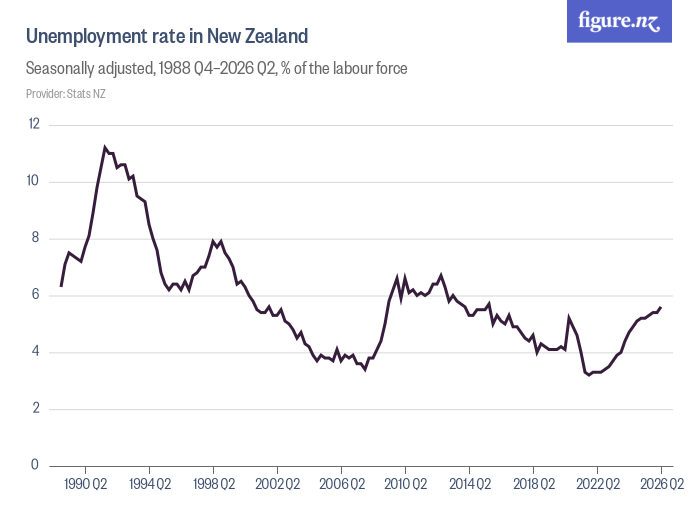
New Zealand already has rising unemployment with our figures at an 11 year high of 5.6%. It’s unclear what the gain to New Zealand will be if we transfer money currently paid to human beings to the owners of offshore large language models in the hunt for efficiency.
On the innovation front, it’s a complex debate to argue whether innovation really has the economic benefits it is claimed to. In the case of Taiwan, the answer is likely yes given the greatest beneficiaries of the AI boom are the chip makers. However, in general, innovation takes about a generation or more to pay off after the initial work is commenced, so we are going to be a while waiting to see those benefits. That isn’t a good argument to halt innovation, but innovation has to be seen as a long term prospect rather than a quick fix. In addition, if the benefits of innovation require growth in use of resources, we have the tiger stop of our environment no longer having any head room in which humans can grow (in terms of our environmental boundaries as above and our overshoot of renewable resources referred to below).
Data centres need a lot of power
With the rapid decline of New Zealand’s aging gas fields, New Zealand energy supplies in general are under pressure. Gas has been used to generate electricity, particularly having a role in keeping electricity supply stable in the face of growing amounts of wind and solar in the grid which generate intermittently; hydropower and geothermal power also provide this ‘firming’ capacity, as can batteries and coal. Managing the increasingly complex mix of energy in our grid is becoming ever more difficult and expensive – that’s why power bills are going up despite wind and solar generation being very cheap when they happening.
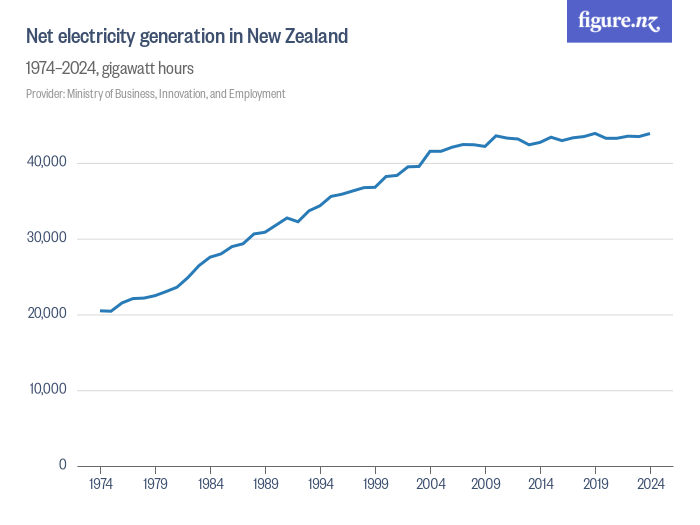
We saw grid demand for electricity climb to an all time peak in July which was very close to the limits of our electricity grid. In other words, we already need more electricity for while the government’s data centre dream will use 15% of our current power requirements. While people think we are building large amounts of wind and solar generation, these are still a small proportion of the total and they require more firming capacity because data centres want energy 24/7. Wind and solar alone will not supply the extra power needed by data centres, unless we are prepared for our lights to turn off to keep data centres running. It’s no use a data centre building a large wind farm then relying on the rest of the grid when the wind isn’t blowing. Will our government mandate that data centres not only supply their own power, but also supply the firming capacity for the power they need?
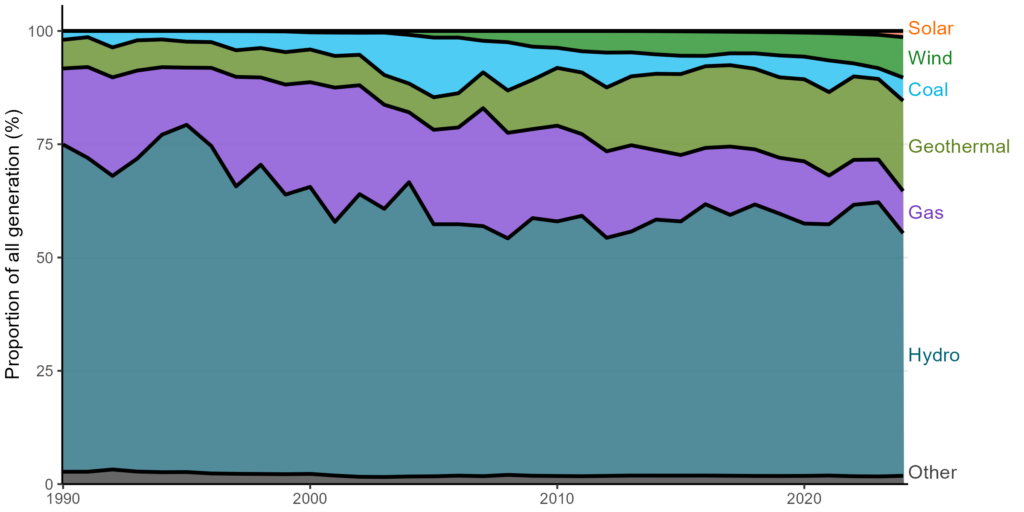
We are told data centres will help solve our power problem because they will drive investment in new energy capacity. I’m back to some boggling here. Why would data centres drive investment in power generation beyond their own needs? There will be no net energy gain to New Zealand unless the energy supply built is greater than required by the data centre. How would that be economic? And which energy sources are feasible to bring online in the required timeframes? The scale we are talking about is doubling our geothermal capacity. Or trebling our wind capacity, but that still won’t be secure power. It would certainly be a new way of doing things for NZ; we haven’t significantly shifted our energy generation capacity for two decades.
To be fair, Boston Consulting (BCG) note all of the above (to be unfair, BCG have also proposed Gazans could be paid USD9000 each to encourage them to leave Gaza and move to countries like Somalia!). And timing is everything – data centres can be built in 2-3 years but new, firmed power generation can’t meet those timelines. BCG note data centres need to be explicitly included in the Fast-track pathway for this reason.
The spectre of nuclear might raise its head but, despite talk of small modular reactors (SMRs) being a decarbonising energy solution, there are only two in operation at present (in China and Russia). These took 11 and 13 years to build (they are early technology) while a Canadian reactor is likely to be commissioned in 5 years. So SMRs are not yet instant solutions and there are all the issues with storage of nuclear waste to contend with – in a tectonically active country like New Zealand it’s unlikely there’s anywhere we can safely store nuclear waste.
We have a consumption problem including, but not limited to, energy
This is where my brain continually returns. The rich world has a consumption problem. Earth Overshoot Day 2026 was 30 July – that’s the data after which date humanity’s demand on nature exceeds what Earth’s ecosystems can regenerate in that year. The last year in which we didn’t overshoot was 1972. There’s not a country on the planet that has a strategy properly recognising this overshoot. Countries who individually ‘undershoot’ do so because they don’t have the capacity to use more resources, not because they don’t want to. And we want to build more infrastructure, faster?
Are we asking the right questions?
In the face of overshoot, trumpeting the need to build more power plants to power more data centres seems like insanity. However, the insistence of the call, driven by imperatives of sovereignty and growth, reduces consideration of whether we need to build data centres, or whether we should build data centres. The focus is shifted to how to build data centres and their associated energy infrastructure.
For example, why aren’t we thinking more about use of small language models, rather than the large language models we now directly associate with Artificial Intelligence (dominated by OpenAI, Anthropic, Google)? And open source models? In New Zealand, the Institute for Public Health & Forensic Research is running their model of 5 million New Zealanders on desktop scale computers. The model is totally sovereign – NZIPHFR use an open source AI (from China) which they are training, in their own premises, on their own hardware. To reiterate my point from above, why aren’t we looking for ways to efficiently power AI and democratise it (using open source systems), rather than helping concentrate the dominance of a few companies.
Follow the money
Follow the money…is that the real question? Where is the money going? It wasn’t the gold miners who made money in the gold rushes, it was the storekeepers and bar owners. Who makes money in a Brave New World of data centres?
- Chip makers: the real winners in the race to AI are Nvidia. Their profit margin is 74%!
- Hyperscalers & other Data Centre operators: data centre operators buy GPUs, commission data centres buildings and rent compute to AI companies. The four hyperscalers (Amazon, Microsoft, Google, Meta) have invested USD650B in data centres in 2026. They are making a massive bet that AI compute is where the money will flow; their revenue is growing although Meta has no direct revenue yet, but they aren’t making profits.
- Model makers: OpenAI, Anthropic, Google – they have revenue but they aren’t making money either. So far, the cost of training the next model (in order to stay ahead of the competition) obviates any profits from the previous model. Model makers are considered the most expensive bets in corporate history; OpenAI will lose an estimated USD14B in 2026 compared with USD20-28B revenue. Can any of these companies beat their negative cashflow positions?
- Energy & Infrastructure: while I rubbished the infrastructure revenue for NZ above, I should have been highlighting it. This is where the money lies. The companies building power plants and installing hardware will be the winners because data centres will have to continuously install and turnover hardware, and buy power. Sellers of energy and infrastructure can supply whichever company wants their services.
So the question in New Zealand around data centres should be, who will build and own the power generation, construct data centre buildings, and install hardware and cooling systems? They will be the organisations making the money. And what I take from this is, the building of data centres is not really about a new digital age, it’s very much harking back to the past. Building large infrastructure to increase wealth is a known quantity with established players.
What happens next?
Your guess is as good as mine but established large players tend to be good and successful at playing their games. The momentum of established business and practice is massive.
Maybe this is an opportunity for revolution of the masses. Opposition to data centres is rising fast as people worry about availability of electricity, the water needed to cool data centres (an environmental impact I haven’t focused on here), and how AI powered by data centres appears to be coming for their jobs. Are people sufficiently uncomfortable to coherently and effectively protest at a scale that will make a difference? I don’t think we are there yet in New Zealand (or most parts of the western world) but I’d love to be proven wrong.
If we are going to protest it’s got to be now because once the infrastructure is underway, it’s already too late.



Discover more from Jane Shearer
Subscribe to get the latest posts sent to your email.