…not you personally, or me personally! This is about surveillance when we were in Xinjiang, China and how it felt like the antithesis of the Mongolian wilds.
China is well known as a heavily surveilled state. We were concerned about crossing into China and particularly Xinjiang as an ‘Autonomous Region’ which is subject to strong control by the Chinese state. The Uyghur people who are some of the indigenous inhabitants of Xinjiang do not want their way of life to be disappeared and their resources to be taken by central government so periodically protest, sometimes vehemently and physically.
When we cycled in China in 2011, it was just before a major crackdown on the Uyghur. At the time, we wondered why concrete block encampments were being constructed in the middle of the Tien Shan mountains. “Why would nomads want to live in little concrete buildings surrounded by fences?” A couple of years later we realised the camps weren’t because the nomads wanted to live in them.
This time around, we cycled through the Kazakh part of Xinjiang which is much less unsettled than the southern Uyghur-dominated areas. And none of our concerns about invasion of privacy, or devices, or control of our route, came to pass. I had wondered whether to take an old computer with few files given stories of people’s electronics being investigated at the border. Then I agonised over whether we should take our normal cell phones. In the end, it all got too hard to be away for 3 months and take other phones and another computer so I took the risk. When the 8 Chinese border agents were trying to make their QR code visa system work, one of the agents asked us, “Do you take photographs?”
“Yes, we said, with our phones,” and held them up. The guy grunted and turned back to the visa machine. There was no further interest in our devices. No detailed investigation of our files. No inquisition about pictures that we had taken (either on entry or exit). No surveillance programs put on our devices. All my concerns came to nothing.
However, surveillance cameras were ubiquitous in Xinjiang. On every traffic light and many other lamp posts besides. On every street corner. When I look through my photographs, it’s a rare street picture that doesn’t show a camera – apparently there are hundreds of millions of them! When we were cycling out of cities early in the morning, we could see multiple flashes from cameras as we pedalled towards them.
As well as cameras to record our moves, police checks were common. There was a first checkpoint about 5km after the border. Two police officers requested our passports and visas, asked where we had come from and where we were going. Then they asked for selfies with us but I was too nervous to ask if we could have a picture with them. Twenty kilometres down the road, as we turned towards Jeminay, a police car swerved towards us and the officers jumped out. Same deal. “Where have you come from? Where are you going? Show us your passports.” I should add this was all couched very politely, through the Dubao voice translation app that everyone used in China. “Please do not be worried,” we were told. “This is a routine police check.” It’s still hard not to worry when three police officers are surrounding you and asking for your passport while holding weapons.
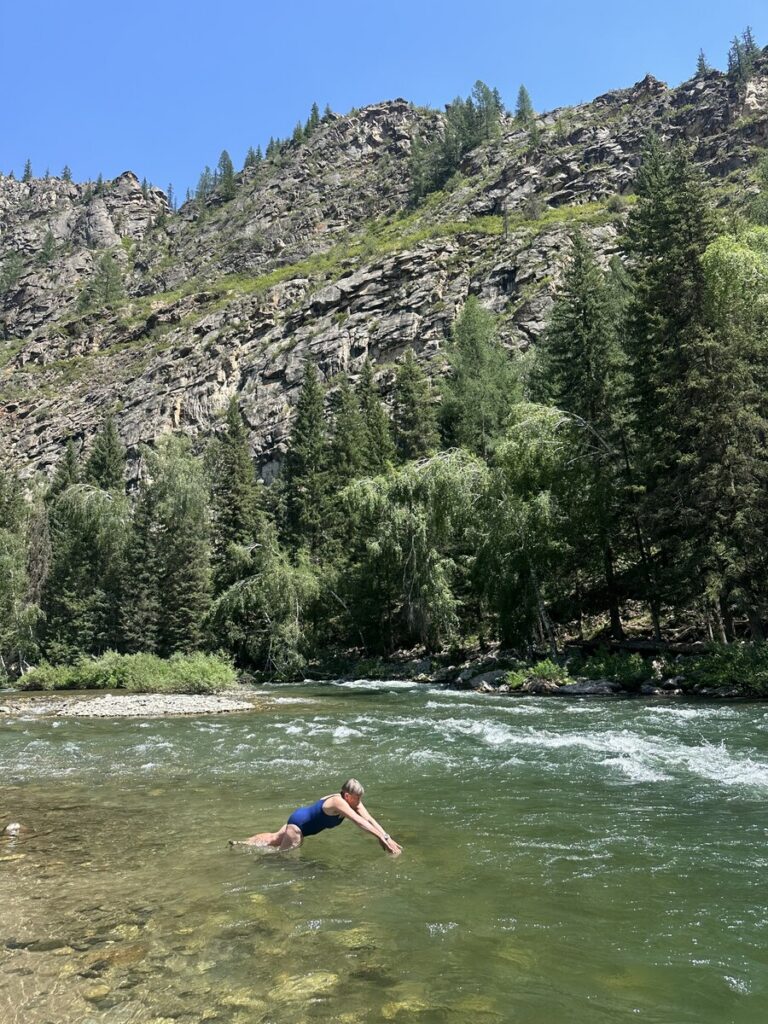
Ten days and a few more police checks later, two police officers turned up at our hidden riverside campsite on the G331 highway. How did they find us? We weren’t visible from the road and there was no cell reception, as the police discovered when they went to use Dubao. A travelling Chinese man from Shanghai we talked with in Mongolia said we might have been dobbed in because that’s an approved practice. We had indeed seen a fisherman go by, up then down the river in the middle of the day (not a good time to be fishing!). I assume he was genuinely fishing, as opposed to the guy in black trousers, white shirt and black vest with a body cam walking up and down the aisle of our flight home between Bejing and Hong Kong who did not appear to be a genuine traveller.
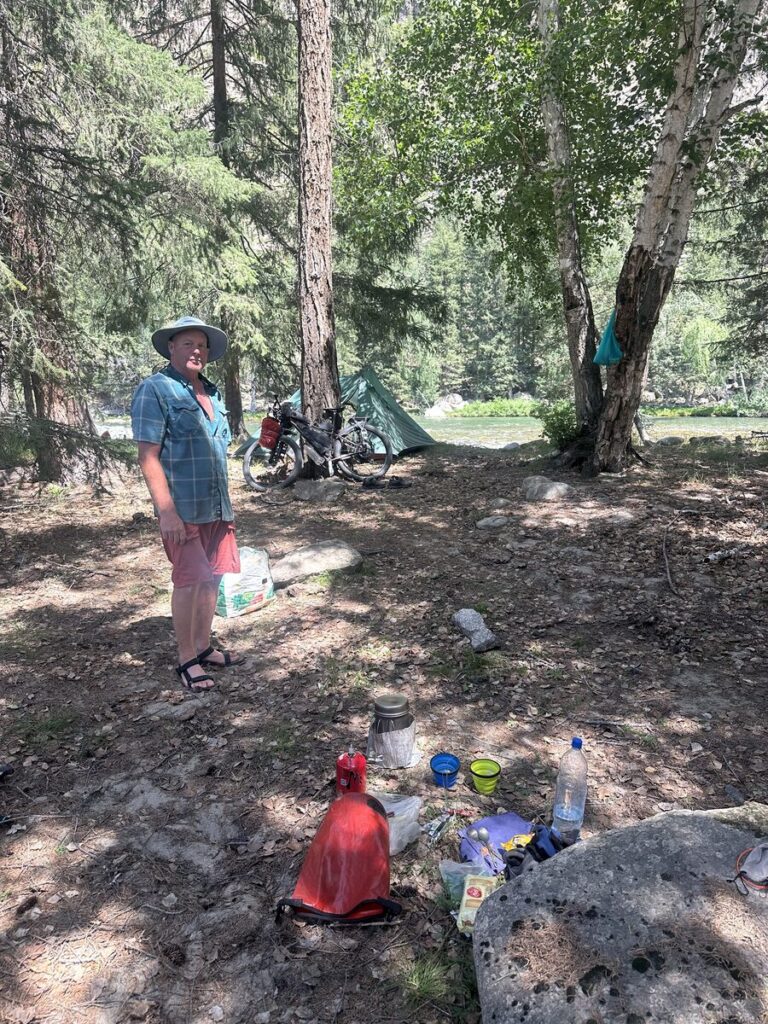
When we were closing on Qinghe, close to the end of our time in Xinjiang, it was no surprise when a passing police car pulled up as we were having lunch by the side of the road. Same rigmarole with four police officers. Even more photos than usual because we had to be pictured looking intently at one of the officers. “So I look like I am doing my job,” he said. Finally I got brave enough to ask if we could have a selfie with the police but the answer, unsurprisingly, was “No.” After the police stop we cycled on – somehow the appeal of lunch on the side of the road diminishes when you feel like you are being watched.
Leaving China took twice as long as entering for no apparent reason. The passport control officer scrutinised documents very very very slowly (up to 30 minutes a person). However, there was still no investigation of our devices, no detailed analysis of our luggage beyond an airport-style machine screening. There was no interest in the photos we might have taken, despite our last police check telling us, “Don’t take photos because you are in a restricted border zone.” We were within 50km of the border at that point although we were still over 100km from the border crossing.
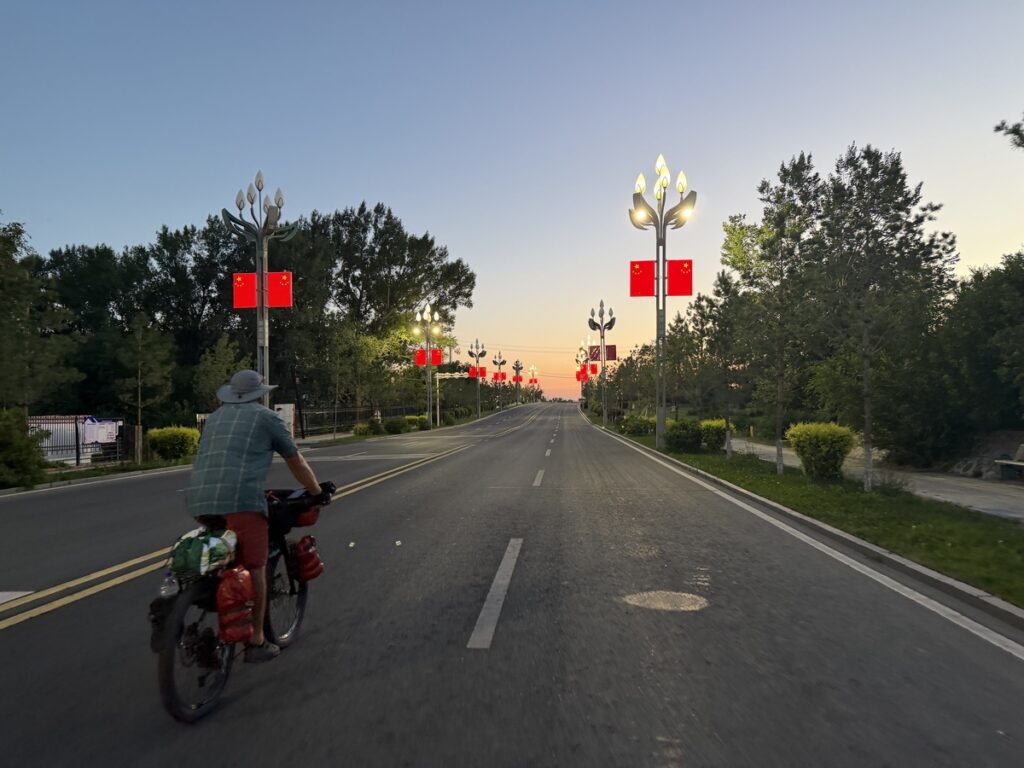
When we finally cycled into the Altai Mountains in Mongolia, on a dirt track with no houses or vehicles or cameras in sight, it felt like a breath of fresh air. There’s something compressing about the feeling of being watched. We are told surveillance cameras make places safer. While it is true that China felt very safe – street sellers leave all their goods on the side of the street overnight! – we had no issues with theft or personal safety in Kazakstan or Mongolia where there were no street cameras. And the counterfactual – London has a very high degree of camera surveillance and constant petty crime. Your phone might be grabbed from your hand by a passing scooterist or off the table in your cafe when you turn your head. You wouldn’t leave anything you liked on the street in London overnight!
Going through airport security in Hong Kong, no document scanning was required. The camera took a photo and the screen said, “Thank you, Jane Shearer.” China will retain a plethora of images of me, matching my images of China – cycling out of town at dawn, eating a boiled egg by the side of the road, waving to children on bicycles, happily entering air conditioned hotel rooms, devouring plates of fried vegetables and noodles. The Chinese citizen we met in Mongolia hadn’t lived in China for years; “I don’t like the control,” he said. I get it.

Discover more from Jane Shearer
Subscribe to get the latest posts sent to your email.
2 thoughts on “I’ve Got My Eye on You…”
Amazing adventures Jane! We didn’t notice so much surveillance in China when we were there (in 2010 to 2015 on the Yellow river plain and Guaungzhou area) but it was super safe and the people were certainly ‘under control’
Im really enjoying your travel blogs. You and Chris are so intrepid!
Amazing adventures Jane! We didn’t notice so much surveillance in China when we were there (in 2010 to 2015 on the Yellow river plain and Guaungzhou area) but it was super safe and the people were certainly ‘under control’
Im really enjoying your travel blogs. You and Chris are so intrepid!